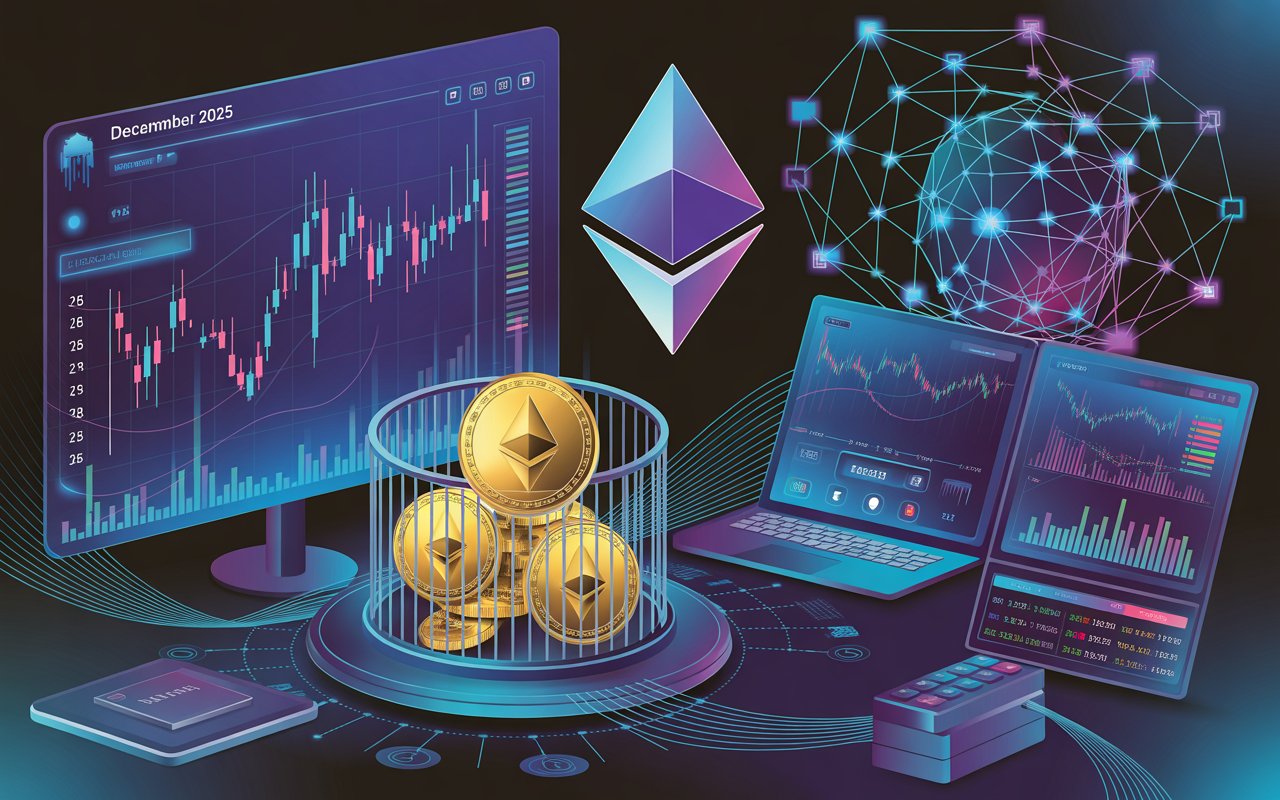
Ethereum Price Action in December 2025
In December 2025, Ethereum (ETH) continues to dominate headlines as market volatility, institutional accumulation, and technological upgrades converge to reshape the digital asset landscape. We observe that ETH has maintained a strong upward trajectory throughout the final quarter of the year, driven by expanding on-chain activity, increased decentralized finance (DeFi) utilization, and a steady rise in staking participation.
The price of ETH has demonstrated resilience despite short-term corrections. Traders are closely monitoring critical resistance and support zones as the asset consolidates after recent rallies. Market sentiment remains bullish, supported by robust trading volumes across major exchanges and sustained inflows into Ethereum-based investment products. The overall market capitalization of Ethereum continues to secure its position as the second-largest cryptocurrency by valuation, reflecting consistent investor confidence.
Technical indicators suggest sustained momentum, with moving averages aligning in a bullish configuration. On-chain data reveals increased wallet activity, growing transaction counts, and rising gas consumption — all signs of network demand and utility expansion.
Major Ethereum Network Upgrades in December 2025
Ethereum’s long-term strength is anchored in continuous protocol innovation. Throughout December 2025, developers have accelerated the rollout of performance optimizations and scaling enhancements aimed at increasing throughput while reducing transaction costs.
The ecosystem continues building on the transition initiated during the Merge, which shifted ETH from Proof-of-Work to Proof-of-Stake. Staking participation has reached record highs, with validators actively securing the network and earning rewards. The increased staking ratio reduces circulating supply, contributing to long-term scarcity dynamics.
Layer 2 scaling solutions are also witnessing explosive adoption. Rollups and modular scaling frameworks are improving transaction efficiency and dramatically lowering fees. As a result, decentralized applications (dApps), NFT platforms, and DeFi protocols are operating more seamlessly than ever.
The Ethereum developer community remains the largest in the blockchain industry. Continuous innovation, security audits, and protocol refinements reinforce Ethereum’s position as the most advanced programmable blockchain platform.
Institutional Investment and ETF Developments
December 2025 marks a significant period for institutional adoption. Major financial institutions are expanding exposure to Ethereum through spot ETFs, structured products, and custodial solutions. The approval and continued inflows into ETH-based exchange-traded funds have legitimized ETH as a strategic digital asset in diversified portfolios.
Institutional demand is not limited to speculative positioning. Corporations are increasingly leveraging Ethereum’s smart contract capabilities for tokenization, supply chain automation, and decentralized identity systems. The integration of blockchain technology into enterprise infrastructure continues to strengthen Ethereum’s real-world relevance.
We see growing participation from hedge funds, pension funds, and sovereign investment entities. The maturation of regulatory clarity in key jurisdictions has reduced uncertainty, encouraging broader capital allocation into ETH-based assets.
DeFi Ecosystem Growth and Total Value Locked (TVL)
The decentralized finance sector built on Ethereum remains the backbone of the crypto economy. In December 2025, the Total Value Locked (TVL) across ETH DeFi protocols shows steady expansion, signaling sustained user confidence.
Lending platforms, decentralized exchanges, derivatives protocols, and yield aggregators are recording increased activity. Innovations in liquid staking derivatives and real-world asset tokenization are unlocking new liquidity streams. Stablecoin utilization on Ethereum has also risen, reinforcing its status as the primary settlement layer for decentralized finance.
Cross-chain interoperability advancements are further boosting Ethereum’s influence. Bridges and interoperability frameworks are enabling smoother capital flow between networks while maintaining as the liquidity hub.
NFT Market Revival and Digital Asset Innovation
Non-fungible tokens (NFTs) have experienced renewed momentum in late 2025. ETH remains the leading blockchain for NFT issuance and trading volume. Blue-chip NFT collections have regained value as institutional players enter the digital collectibles space.
Beyond art and collectibles, NFTs are expanding into gaming, intellectual property management, ticketing, and identity verification. Enterprise-grade NFT solutions built on ETH are creating new revenue channels for creators and brands.
The rise of tokenized real-world assets (RWAs) further enhances ETH’s ecosystem. Real estate, commodities, and financial instruments are increasingly being represented as blockchain-based tokens, unlocking liquidity and improving transparency.

Ethereum Staking and Validator Expansion
Staking continues to be a critical pillar of ETH’s ecosystem. December 2025 data shows a substantial percentage of the total ETH supply locked in staking contracts. Validator participation has increased globally, strengthening decentralization and network security.
Liquid staking protocols allow participants to maintain liquidity while earning staking rewards. This innovation has significantly lowered entry barriers and improved capital efficiency within the network.
The reward structure remains attractive, especially as network activity drives transaction fee distribution. Long-term holders benefit from both staking yields and potential price appreciation.
Gas Fees and Scalability Improvements
One of the most discussed aspects of Ethereum has historically been gas fees. In December 2025, we observe meaningful improvements in cost efficiency due to scaling enhancements and optimized transaction batching.
Layer 2 rollups now process a significant portion of network transactions, reducing congestion on the main chain. As adoption spreads, average transaction fees have become more predictable and manageable for users and developers alike.
Scalability improvements position ETH as a viable infrastructure for global-scale decentralized applications, financial services, and enterprise-grade systems.
Regulatory Landscape and Global Adoption
Regulatory clarity has played a pivotal role in Ethereum’s growth in 2025. Several major economies have introduced structured digital asset frameworks that recognize Ethereum as a decentralized commodity-like asset rather than a security.
Governments and financial regulators are increasingly collaborating with blockchain developers to explore central bank digital currencies (CBDCs) and tokenization initiatives built on Ethereum-compatible networks.
Global adoption trends indicate that Ethereum is no longer confined to crypto-native users. Traditional institutions, fintech startups, and multinational corporations are actively integrating Ethereum-based solutions into operational workflows.
On-Chain Metrics and Market Sentiment
On-chain analytics reveal healthy network fundamentals. Active addresses, transaction volumes, and smart contract deployments are trending upward. Whale accumulation patterns indicate long-term confidence from large holders.
Funding rates in derivatives markets suggest balanced leverage, reducing the likelihood of extreme liquidations. Open interest remains elevated, reflecting sustained trading interest.
Social sentiment metrics and search trends demonstrate heightened public awareness as Ethereum continues to capture mainstream attention during December 2025.
Ethereum Price Outlook Beyond December 2025
Looking ahead, Ethereum’s trajectory is supported by strong fundamentals, institutional adoption, and technological evolution. Supply dynamics remain favorable due to staking lockups and deflationary mechanisms tied to transaction fee burns.
The expanding use cases across finance, gaming, real-world asset tokenization, and enterprise infrastructure create long-term demand for ETH as a utility and settlement asset.
We anticipate continued ecosystem expansion as developers innovate and institutions deepen their engagement with Ethereum-based products. Market cycles may introduce volatility, but structural growth drivers remain firmly intact.
Conclusion
December 2025 reinforces Ethereum’s leadership in the blockchain sector. Its combination of technical innovation, institutional credibility, and real-world application establishes a durable foundation for sustained growth.
Ethereum is not merely a cryptocurrency; it is a comprehensive decentralized infrastructure powering the next generation of digital finance and programmable assets. As adoption accelerates and network efficiency improves, Ethereum’s role in the global financial system continues to expand.